
How to Lucid Dream: The Complete Guide (MILD, WBTB and More)
Waking up inside a dream, knowing it is a dream, and choosing what happens next: that is lucid dreaming, and it is a real, well-studied skill rather than a party trick of a lucky few. Most people can learn it. This guide walks you through the whole path: the two habits that make lucidity possible, a simple plan you can start tonight, the techniques with the best scientific evidence behind them (MILD, WBTB, SSILD), how to stay in the dream once you are aware, and what the research says about benefits and safety.
What Is Lucid Dreaming?
A lucid dream is a dream in which you know you are dreaming while the dream is still happening. That awareness ranges from a faint 'wait, this is a dream' to full clarity in which you can steer the story, change the scenery or simply explore. It is not mysticism: in 1975 the British researcher Keith Hearne recorded a sleeping volunteer signalling with deliberate eye movements from inside a dream, and Stephen LaBerge soon replicated the feat at Stanford. In 2021, researchers went further still, holding simple real-time conversations with lucid dreamers who answered maths questions with their eyes while fast asleep.
And yes, you are genuinely asleep the whole time. Lucid dreams happen almost entirely during REM (rapid eye movement) sleep, the stage in which the brain is highly active, most vivid dreaming occurs, and the body is safely paralysed. REM periods grow longer towards morning, which is why nearly every technique in this guide aims at the final third of the night.
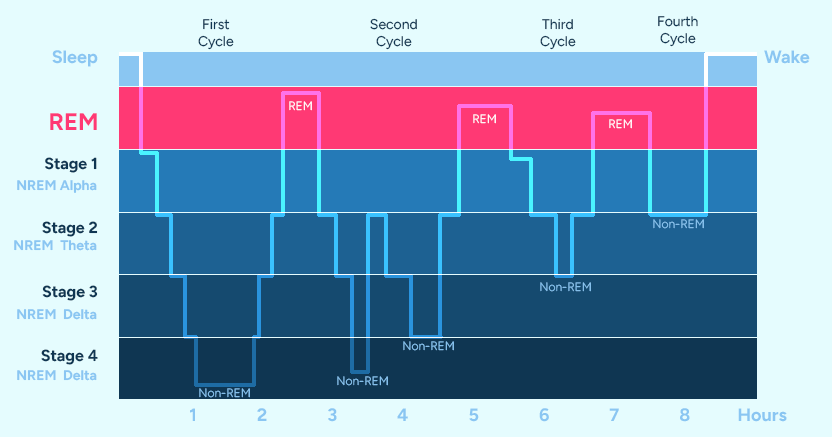
Lucid dreaming is also far more common than most people assume. A meta-analysis of fifty years of research found that about 55% of people have had at least one lucid dream, and around 23% have them monthly. The difference between the occasional accidental lucid dream and having them regularly is practice: the same study tradition shows that frequency responds to training, which is exactly what the rest of this guide is for.
Before the Techniques: Two Habits That Make Lucidity Possible
Every induction technique stands on the same foundation. Skip these habits and MILD or WBTB will feel like rolling dice; build them and the techniques start to work with you.
- Keep a dream journal: write down whatever you remember the moment you wake, even fragments. Recall is the raw material of lucidity: you cannot recognise you are dreaming if you barely remember dreams at all. Within a couple of weeks the journal also reveals your personal dream signs, the odd recurring details (a strange house, a missed train, a person who should not be there) that become triggers for lucidity.
- Do reality checks all day: genuinely question whether you are dreaming several times a day and test it. Done with real attention rather than on autopilot, the habit carries into your dreams, where the test fails and lucidity begins.
- Protect your sleep: seven to nine hours, on a reasonably regular schedule. Lucid dreams live in REM sleep, and REM is the first thing a short night cuts. A sleep-deprived brain does not get lucid; it just sleeps.
- Practise a little mindfulness: meditation trains exactly the skill lucidity depends on, noticing your own state of mind. Even ten minutes a day measurably sharpens the self-awareness that reality checks rely on.
Reality Checks That Actually Work
A good reality check exploits something dreams are bad at simulating. Three have stood the test of time:
- Look at your hands: in dreams, hands are often distorted, blurry or have the wrong number of fingers. Really look, and ask the question as if the answer might be yes.
- Pinch your nose and try to breathe: in a dream you will still be able to breathe through a pinched nose. It is quick, discreet and one of the most reliable checks there is.
- Read something twice: look at a piece of text, look away, look back. In dreams the text usually changes, melts or stops making sense.

If you like a more personal touch, borrow an idea from the film Inception, where Cobb carries a spinning top that behaves impossibly in dreams. Hollywood dramatises it, but the principle is sound and you can build your own version:
- Choose a small object you handle every day, such as a coin, a ring or a keychain.
- Learn it by heart: its weight, texture and exactly how it behaves when you flip or press it.
- Test it in dreams: when it turns up behaving strangely, that mismatch is your signal that you are dreaming.
How to Lucid Dream Tonight: A Seven-Step Plan
Here is the whole method in one evening-to-morning routine. It combines the three techniques with the strongest evidence (reality testing, WBTB and MILD), the same combination that came out on top in the largest induction study to date.
- Through the day, do at least ten genuine reality checks, especially whenever anything feels even slightly odd.
- Go to bed at your normal time and plan for a full night. Lucidity feeds on REM, and REM feeds on sleep.
- Set a gentle alarm for five to six hours after you fall asleep.
- When it wakes you, write down whatever you were dreaming in your journal, in as much detail as you can.
- Stay awake for twenty to thirty minutes. Keep the lights low and your mind on dreaming: reread old journal entries or a section of this guide.
- Back in bed, practise MILD: repeat 'next time I'm dreaming, I will remember I'm dreaming' while vividly imagining yourself back in tonight's dream, noticing it is a dream. Hold that intention as you drift off.
- If you become lucid, stabilise first (rub your hands together, touch something) before trying anything ambitious, and write everything down when you wake.

Get Ruya App
Track your dreams anywhere and unlock deeper insights.
Which Technique Works Best? A Comparison
In the National Australian Lucid Dream Induction Study, the combination of reality testing, WBTB and MILD clearly outperformed the techniques used alone. Here is how the main methods compare in practice:
| Technique | How it works | Best for | Effort |
|---|---|---|---|
| Reality testing | Question whether you are dreaming many times a day until the habit appears inside your dreams | Complete beginners; the foundation for everything else | Low, spread through the day |
| MILD | Repeat an intention and visualise becoming lucid as you fall back asleep | The best-evidenced single technique | A few focused minutes at night |
| WBTB | Wake after five to six hours, stay up briefly, then return to sleep straight into REM | Supercharging MILD; nights when you can sleep in | Medium, costs a little sleep |
| SSILD | Cycle your attention through sight, sound and touch while drifting back to sleep | People who find MILD's phrasing awkward | Medium |
| WILD | Keep the mind aware while the body falls asleep, entering the dream directly | Experienced dreamers | High, expect strange sensations |
MILD: The Best-Evidenced Technique
MILD (Mnemonic Induction of Lucid Dreams) was developed by Stephen LaBerge and remains the technique with the strongest research behind it. It uses prospective memory, the everyday skill of remembering to do something later, and aims it at your dreams. In the Australian study led by Denholm Aspy, people who practised MILD and fell asleep within about five minutes of finishing the exercise became lucid in roughly 46% of their attempts that week, an extraordinary rate for beginners.
How to Practise MILD
- Recall the dream: when you wake from a dream, at night or in the morning, hold on to it and note the details in your journal.
- Set the intention: as you settle back to sleep, repeat a single clear phrase such as 'next time I'm dreaming, I will remember I'm dreaming'. Mean it, rather than just recite it.
- Visualise becoming lucid: replay the dream you just had and imagine noticing a dream sign, realising it is a dream, and calmly taking control.
- Fall asleep on the intention: keep the phrase and the image gently in mind as you drift off, letting them be the last thing in your awareness.
Three things raise your odds noticeably: practise on nights when you can fall back asleep quickly (the five-minute window matters), visualise recent dreams rather than invented scenes, and stay relaxed about results. MILD rewards calm consistency, not effort.
WBTB: Wake Back to Bed
WBTB (Wake Back to Bed) is less a technique than a delivery system: it places you, awake and intention-primed, right at the doorstep of your longest REM periods. On its own it helps; combined with MILD it is the most effective approach studied so far.
How to Practise WBTB
- Set an alarm for five to six hours after you fall asleep, which lands you near the REM-rich final third of the night.
- Get up briefly: stay awake for twenty to sixty minutes. Keep lights dim and screens away; read about lucid dreaming or review your journal to keep your mind on the subject.
- Prime your intention: as you head back to bed, move straight into MILD: the phrase, the visualisation, the quiet certainty that you will notice the next dream.
- Fall asleep gently: if sleep will not come, relax your body deliberately from toes to head. A tense return to bed defeats the purpose.
- Experiment with the wake time: some people get the best results after twenty minutes awake, others after a full hour. Two or three nights a week is plenty; WBTB costs sleep, so do not run it nightly.
If you only take one thing from this guide, take the pairing: WBTB opens the REM window and MILD walks through it. That combination, on top of daily reality checks and a living dream journal, is the closest thing lucid dreaming has to a proven recipe.
SSILD and WILD: Two More Worth Knowing
SSILD (Senses Initiated Lucid Dreaming) is a newer, pleasantly mechanical alternative to MILD. After a WBTB wake-up, you cycle your attention slowly through three channels while lying still: what you see behind closed eyes, what you hear, and what your body feels. A few unhurried cycles, then let yourself fall asleep. No affirmations, no visualising; the gentle sensory attention alone primes awareness, which makes SSILD a favourite for people who find MILD's inner monologue awkward.
WILD (Wake Initiated Lucid Dreaming) is the advanced route: keeping a thread of awareness intact while the body falls asleep, so you enter the dream directly with no gap in consciousness. On the way in you may meet hypnagogia, the borderland of drifting images, sounds and sometimes a brief sensation of being unable to move. These moments can feel strange, but they are ordinary physiology and pass in seconds. WILD delivers the most vivid entries of any method, and it is also the hardest to pull off, so treat it as a later milestone rather than a starting point.
How to Stay in a Lucid Dream: Stabilisation
Most beginners lose their first lucid dreams within seconds, usually to a jolt of excitement that wakes them. The fix is to anchor yourself in the dream's senses before you do anything else:
- Rub your hands together the moment you become lucid. The friction floods your attention with dream sensation and steadies the scene.
- Touch things and name them: a wall, grass, a door handle. Engaging touch and speech keeps the dream rendering around you.
- Say your intention out loud: a calm 'more clarity' or 'stay' spoken in the dream is surprisingly effective.
- Spin if the scene fades: when everything goes dark, spin your dream body like a dancer, a rescue technique described by Paul Tholey and popularised by LaBerge. A new scene often forms around you.
- Stay curious, not thrilled: strong emotion is the number one dream killer. Observe first, experiment second, celebrate after you wake up.
What Lucid Dreaming Is Good For
Beyond the sheer wonder of it, research and clinical practice point to real benefits:
- Nightmares and emotional healing: lucidity turns a nightmare from something that happens to you into something you can face, question or simply end. Lucid dreaming techniques are studied as a therapy for recurring nightmares, and many dreamers use the safety of a known dream to meet fears on their own terms.
- Creativity: the dream world builds itself from your own associations, and lucid dreamers deliberately mine it: asking characters questions, trying out designs, playing unwritten music.
- Skill rehearsal: sports scientists have shown that practising movements in lucid dreams can improve waking performance, which makes sense: the brain rehearses the same motor programmes, minus the risk.
Is Lucid Dreaming Safe?
For most people, yes: lucid dreaming is a natural experience that more than half the population has had by accident, and the techniques in this guide are gentle behavioural habits, not interventions. A few honest cautions still apply:
- Certain conditions call for caution: people living with psychosis, schizophrenia or bipolar disorder are generally advised not to practise induction techniques, as deliberately blurring the line between dreaming and waking can be destabilising. If that applies to you, talk to your clinician first.
- Guard your sleep: WBTB deliberately interrupts the night, and overusing it leaves you tired. Two or three attempts a week keeps the hobby from becoming a sleep debt.
- Expect the occasional oddity: false awakenings (dreaming that you woke up) and brief sleep paralysis sensations come with the territory. They are harmless and, helpfully, both are excellent cues to do a reality check.
- Keep it in balance: if dreaming starts to feel more important than your waking life, ease off. Lucidity is at its best as an addition to a good life and a good night's sleep, not a replacement for either.
A Short History: From Aristotle to Two-Way Conversations
People have noticed themselves dreaming for as long as records exist. Aristotle described it plainly more than two thousand years ago; the Dutch psychiatrist Frederik van Eeden coined the term 'lucid dream' in 1913; Keith Hearne captured the first laboratory proof in 1975 with his volunteer Alan Worsley's pre-agreed eye signals; Stephen LaBerge built the scientific field at Stanford and developed MILD; and in 2021 an international team led by Karen Konkoly showed that lucid dreamers can answer questions in real time from inside REM sleep. Few fringe curiosities have ever graduated so thoroughly into laboratory science.
Often, when one is asleep, there is something in consciousness which declares that what then presents itself is but a dream.
Aristotle, On Dreams (c. 350 BC)
- Stephen LaBerge: proved lucidity scientifically at Stanford, invented MILD and wrote the field's classic handbook.
- Keith Hearne: recorded the first ever signal from inside a dream, in a Hull sleep laboratory in April 1975.
- Paul Tholey: the German psychologist who systematised induction and control techniques, including the spinning rescue.
Every technique in this guide begins and ends in the same place: a dream journal. It trains the recall that lucidity depends on, supplies the dream signs your reality checks watch for, and gives MILD its raw material. Ruya was built around exactly that loop: the journal is free, reminders keep the morning habit alive, and when a dream feels like more than a diary entry, the Lucid Dream Exploration method helps you unpack what your dreaming mind was doing. Tonight is as good a night as any to start.


